今年2011年が始まってもう一カ月過ぎようとしています。
私の年末年始をブログしたいと思います。
私は11月29日から1月20までザンビア教育省にある試験局にインターン学生として研修をしてきました。2009年の8、9月とインターンとして訪れたので、今回は二回目の訪問となります。そのおかげで年末年始をザンビアで過ごすことになりました。ザンビアには広島大学のザンビアプログラムに参加する学生もいて、彼らとも久しぶりに会いとても刺激を受けました。
ザンビアの年末年始といっても、今年は週末だったこともあり、普段の週末のような感じでした。私はビールが好きなので、ザンビアビールを片手に、自分で作ったパスタを食べながら年越ししました。今年そばならぬ年越しパスタです。
活動は自分の実力のなさを感じながらも、前に進めたように思っています。今後はその活動をさらに充実させて、自分の勉強のほうもしっかりいいものにしたいと思います。
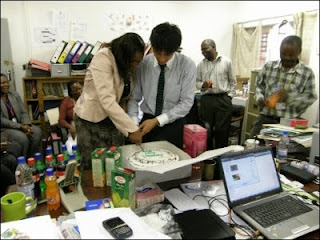
帰国のときには、盛大なお別れパーティーを開いてくれてものすごく感動しました。同僚のビューティフルレディーとケーキ入刀しちゃいました^^。とてもいい思い出とともに、今後の研究活動にも気合が入りました。 
2011年1月26日水曜日
年末年始

2011年1月15日土曜日
授業の1コマ
先生:1000円の10割はいくら?
生徒:100円です!
これは、中学2年生の塾での授業の1コマです。連立方程式の文章問題「男子○%と女子○%が虫歯をもっていて、合計○%でした。・・・」を解いている最中、割合がわからないということで、小学校レベルにもどって説明していた時の様子です。
割合は、生活上なじみのあるものであるはずなのに理解に乏しいのはなぜだろうかーその理由の一つとして割合分数の考え方が定着していないことがあると考えています。そこで再び中2で、「○%は全体を100個に分けたうちの○個をあらわす・・・」と図入りで説明します。
しかし今回は少し変化を加えてみました。というのも、概念形成の手段としての言葉の使用、特に生徒の感覚に結び付いた言葉の使用が大切であると思うようになったからです。そこで意識的に「言葉」を以下のように使ってみました。
先生:部活の先生に「試合で100%の力をだしなさい」と言われたら、みんなはどのくらいの力を出すの?
生徒:自分の力、全部。
先生:そう「全部」だよね。
100%は「全部」ということなんだよ。割は10割が「全部」なのよ。
というわけで「全部」という言葉と実感を意図的に取り入れてみました。
以下はその後の脱線した授業です。
生徒:先生、なんで2つ(%と割)もあるの?1つでいいのに・・。
先生:みんなは、どっちがいいの?
生徒:%!
先生:へえ、でも上毛かるたの「わ」は何だっけ?
生徒:わさんのたいか、せきこうわ
先生:そう、和算。割は和算からきているのよ。ちょうど社会で明治維新をやっているから説明するけど・・・(説明つづく)。
「二八そば」とかあるでしょう?
生徒:「七三分け」とかもあるね(笑)
One section of a math lesson
Teacher: “How much is 10-wari of 1000yen? (In Japanese the relative value of 0.1 is called “1-wari”)
Student: 100yen!
This is a one section of a math lesson I taught to Year 8. As we were solving simultaneous equation, some students asked me to explain the meaning of percentage and Wari. So I started explaining from a basic level.
Why is relative value difficult to understand for students even though it is often used in our lives? I think one of the reasons is lack of understanding about the meaning of a fraction as a relative value. Therefore I usually started to explain as follows with a diagram.
“ Firstly you divide everything into 100 pieces and finding 60% means 60 pieces out of 100 pieces.”
But now I have tried to change my teaching, because I realized using words which are related to students’ feeling in their real lives is very important to build conception. Therefore I used specific words on purpose like “all”.
T: How much amount of your power do you use when coach tells you to use 100% of your power?
S: All. All of our power.
T: Yes, it’s all, so 100% means “all”. 10-wari means “all” too.
This shows how I intentionally took the word “all” and a situation which relates to life.
S: Why do we use two types of relative value, % and wari? I think it’s enough to use one .
T: Which one do you prefer?
S: %
T: Well, do you know JOMO Card? Can you tell the WA card?
S: “ Wasan no taika SEKI KOUWA” (It means KOUWA SEKI is one of the greatest mathematician. Wasan means Japanese math.)
T: Yes. Wari comes from Wasan, Japanese math. At the beginning of Meiji era we imported・・・(I explained the history.) Do you know “ NIHACHI soba?”(NIHACHI means 2:8)
S: Do you know “SHICHISANWAKE” ( It is a traditional Japanese man’s hair style parted into 7:3. SHICHI: SAN means 7:3.)
T&S: (laughing)
2010年11月5日金曜日
アフリカ教育研究フォーラム
先月の22日から23日にかけて大阪大学で開催されてアフリカ教育研究フォーラムに参加てきました。エクアドルの子どもたちに焦点を当てた研究の傍ら、アフリカにも目を向けた研究を少しずつですが進めてきています。
アフリカ教育研究フォーラムなので、広島大学からはザンビアに関する研究が中心となります。他大学の方の研究を見ると、その内容もさることながらプレゼン能力が高いことに、大変勉強になりました。私もしっかり自分の意見を話せるように、そういったスキルも身に付けていきたいです。
私の勉強内容は、子どもたちが勉強したことの成果の特徴を把握するというものです。なぜならば、そこを把握することで数学教育という側面で学力向上を考えたときに、特異な部分もモニタリングが必要だからです。以前行った内容には、致命的なミスが見つかったので、改めて分析を行った内容を発表しました。でも当初の発表内容の予定の半分ぐらいしか進まず、ちょっと不完全燃焼という気分ですが、それは次の課題になりそうです。
エクアドルと今後はザンビアに焦点を当てることになると思いますが、両国に繋がっていけるように努力していきたいと思います。
フォーラムを主催してくださった方々ありがとうございました。

International Workshop 2010 in IDEC
We had a two-day workshop last Wednesday and Thursday.
The theme was 'Interrelation of Social Context and Math/Scientific
Literacy'.
We received some guests from Australia, Bangladesh, China, Mongolia and
Kenya.
There were Mohsin san, Jin san and Oyunaa san, who are baba lab OBs/OG.
I haven't seen Mohsin san and Jin san since I started off to Zambia in
2005 and it was
really long time no see (HISASHIBURI). (Well. I met Oyunaa san in a
conference in Tokyo a couple months ago.)
When I was in the first year of the master's course, Mohsin san and Jin
san were busy with writing their thesis.
I did not imagine how difficult the work they were engaged in was at
that time.
Now I am in the same situation, writing up my doctral thesis.
They, during the reception, gave me some advice and I really enjoyed
talking to them.
All the presentations gave us some deeper consideration and the
discussions we had were really fruitful.
Everytime I take part in this sort of conferences/seminars, I ask myself
'What can mathematics education contribute to the society?''
And there are no clear answers. I am sometimes really confused, but I
have to continue to consider it.
Well, anyway, thank you(our lab members) very much for organising this
occasion and we hope to see you(OB/OG) again!


Nagisa Nakawa
2010年10月29日金曜日
New member is coming!!
My research title is Examining Secondary School Mathematics Lessons from the the perspective of teachers and student involvement in Malawi: the case of South East Education Division. I am very happy to be in Japan more specifically at Hiroshima University as a graduate student. I know I will not go back to my country the same. We only have "to know that we don't know" to know and become wise.

2010年10月27日水曜日
国際教育開発フォーラム in 神戸
神戸に行ってきました。今回、場馬研からはD1の渡邊さんと私だけでしたが、神戸大学、名古屋大学、早稲田大学の院生や先生方の話を聞けて刺激になりました。特に同じM1で発表されている方や英語が堪能な方などの発表は自分もがんばらなくてはと本当に刺激になりました。
また、懇親会等で他の大学の院生とも仲良くなれたのも良かったです。特に今回は場馬研からは2人だけ、IDEC全体で見ても院生は3人しか行っていなかったので、身内で固まることも無く他大学の方々との交流が多かったような気がします。次回開催は韓国ですが、その時には是非私も発表できるような研究を出来るように精進していきます。
最後に、快く一緒に写真を撮っていただいた吉田先生、小川先生、黒田先生、山田先生、オーガナイズをしていただいた神戸大学の皆様ありがとうございました。


2010年9月23日木曜日
お世話になりました!MaSA
Hi, I am MaSA, completing Master course soon.
Although I have a houseful of memories in Hiroshima,
one of the best is International Friends.
I went to drink last night with Malawian friends who assisted me so much.
I dearly enjoyed the time with them after so long recent.
The other day, I completed the tentative translation of my thesis into English,
and sent it to people who assisted me in Kenya, Malawi and Japan.
yayaya, I know I need further wordsmith in my English....
BTW, many of them replied very soon, and they also showed appreciation to me...
I was so glad to hear it, and I might at least manage to return a favor.
It is needless to write my memories here.
I am proud of one thing in IDEC,
that I can confidently say I have friends all over the world...
This is my precious diamond in my hand.
Let's join to the Earth!!
M2 MaSA
もうすぐ修了の松山です。
色々な思い出がたくさんありますが、
その中でも格別なのは、やっぱり留学生たちとの交流でした。
昨夜はお世話になったマラウイ人たちと駅前の酒場へ行ってきました。
いやはや、久しぶりにすごく楽しい気持ちでお酒が呑めた。
つい先日に、研究で世話になった留学生とケニア、マラウイの人たちに、
自分の英訳した修論を送った。
英文のレベルは、まだまだ推敲を重ねる必要ありですが…。
みんなすぐに返事をくれて、とても喜んでくれた。
最低限の恩返しができた気がします。
ここにダラダラと思い出を語る気はないが、
IDECに来て、世界中に仲間がいると言えるのが、
やっぱ最高の宝物。
Let's join to the Earth!!
M2 松山


登録:
投稿 (Atom)

 投稿


